En esta página
Crimson Moon does not work like a normal campaign you clear once and shelve. It runs on a repeatable mission loop: you leave the Church hub, fight a mission, come back, spend what you earned at the War Table, and go out again — with new modifiers and objectives waiting each time. This piece breaks down exactly how the Church and War Table connect between runs, how dynamic difficulty ties into optional co-op, and what ProbablyMonsters genuinely hasn’t confirmed yet ahead of the September 1, 2026 launch.
En resumen
- Crimson Moon is built around replayable missions, not a one-and-done linear campaign — progression persists between runs
- The Church is the permanent hub for upgrades and NPCs; the War Table is where you plan the next mission from that hub
- Difficulty and enemy composition scale dynamically to your skill and to whether you’re playing solo or in two-player co-op
- Run length, the in-game economy, the full modifier list, and the actual names of the Dead Gods are all still unconfirmed
Desbloqueo completo del equipo
Every weapon, armour piece and trinket the game gates, unlocked on your account — all nine…
What Are the War Table and Church Hub in Crimson Moon?
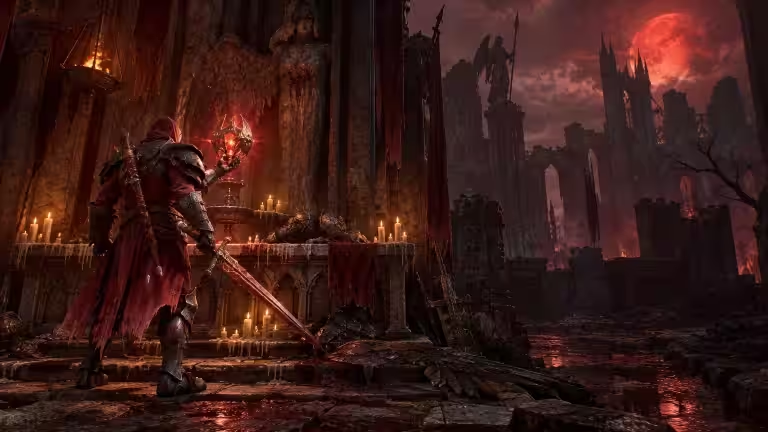
The Church and the War Table are two parts of the same home base, not two separate places. In between runs, you return to the headquarters of the Church, your home base for permanent upgrades and NPC interactions, then survey the city and plan your next mission via the War Table. Steam’s own feature list frames it the same way: Seek Sanctuary Between Runs – The Church is your home base for upgrades, NPC interactions, and War Table planning. This is the loop players ask about most before wishlisting the game, alongside how the optional co-op actually holds up, which is covered separately in the co-op breakdown.
| Sistema | What it is | What you do there |
|---|---|---|
| Church | Permanent home base hub | Spend earned resources on lasting upgrades, talk to NPCs |
| War Table | Planning interface inside the Church | Survey Gildenarch, pick your next mission and difficulty |
Anyone who would rather not spend the evenings on it can hand Boosting de Crimson Moon to our crew instead — same account, same progress, played by hand.
How Missions Actually Chain in Crimson Moon (Not a Linear Campaign)
If you went in expecting a story you finish once and never touch again, recalibrate. Crimson Moon’s core structure is High Risk, High Reward Missions – Every successful run presents new missions, modifiers, and skill achievements, which is a roguelite framing rather than a fixed level list. The official announcement backs this up directly: dynamic level design and evolving enemy compositions ensure that no two incursions are identical, and difficulty modifiers allow players to unlock greater rewards by taking on greater challenges. That means clearing a mission doesn’t retire it — it opens the next tier of objectives and modifiers on the same location, and whatever permanent upgrades or gear you banked at the Church carry into that next attempt.
Progression itself is designed to be persistent rather than run-specific. Success awards new mission modifiers, equipment sets, and permanent skill points. So the campaign isn’t a single arc with credits at the end — it’s closer to a mission board that keeps escalating, and your character keeps getting stronger across every trip back to the Church. For a player buying it on release day expecting to “beat” it in a weekend, the honest expectation to set is: you’ll hit story beats and boss walls, but the structure wants you circling back through Gildenarch’s districts repeatedly, at higher difficulty, for better rewards.
Note
ProbablyMonsters itself describes Crimson Moon as a gothic action-adventure RPG, and Steam files it under Action, Adventure, and RPG tags. Community shorthand calling it a “roguelite” or “soulslike” describes the mission loop and combat feel, not an official label from the studio.
Confirmed 2 September: a Run Is Three Missions Plus a World Boss
A week after this guide first went up, and a day after launch, Team Metal put a number on the loop that the pre-release material never gave: a full run is three missions followed by a World Boss. Returning to Sanctus Clypeus between those missions does not end the run.
That one sentence explains the complaint the studio says it keeps receiving as a bug report. The Loadout Station stays locked until the run is over — you either finish it or you die. If you came back to the hub expecting to swap gear between missions and found the station unavailable or floating above you, nothing is broken; you are still inside the run.
The same post cleared up a second thing players were filing as a bug. Purifying an item permanently unlocks it at Common quality, whatever rarity you found it at. Purify a Rare drop and the permanent version in your Collection still begins at Common — the item is unlocked, not the roll.
What the studio still has not said is whether a run can be abandoned voluntarily. The post gives two endings and no third: complete the full run, or die.
Step-by-Step: How a Church-to-War Table Loop Chains Together
Sigue estos pasos para hacerlo rápidamente.
-
1
Start at the Church
you land here between every run to bank resources and talk to NPCs.
-
2
Spend on permanent upgrades
put earned resources into lasting power gains rather than temporary buffs.
-
3
Check the War Table
this is where you actually choose the next operation and survey the city state.
-
4
Pick your next mission
including whatever modifiers your last successful run unlocked.
-
5
Run it solo or with a partner
difficulty and enemy makeup adjust automatically to your choice.
-
6
Return to the Church
bank whatever you earned, then repeat with the next tier of modifiers available.
Dynamic Difficulty, Party Size, and Optional Co-op
Difficulty in Crimson Moon isn’t a menu setting you pick once — it reads your performance and your party. Steam’s listing puts it plainly: Set Your Difficulty – Dynamic difficulty scaling allows every mission to match your skill – but with higher difficulties come greater rewards. That scaling extends to the optional two-player co-op, which is confirmed to be entirely optional rather than required to progress. As one preview outlet summarized it, players can tackle the adventure solo or team up in optional two-player co-op, with dynamic difficulty and enemy scaling designed to adapt to the party size.
Bringing a second player changes more than the number of bodies on screen. Co-op mechanics introduce active ability synergies, shared life pools, and the capacity to resurrect fallen partners mid-battle, and enemy compositions and overall difficulty automatically adjust depending on player count, ensuring that adding a partner increases tactical complexity without destroying the game’s brisk pacing. The detailed rundown of how those shared lives, synergies, and revives actually function is broken down in the dedicated co-op explainer covering shared lives — worth reading before you decide whether to run solo or bring a friend into the War Table with you.
Whether you’re on a rig that barely clears the minimum spec or one built for the recommended settings, party-size scaling applies the same way — the PC requirements breakdown is worth checking before launch day if you’re planning co-op sessions with a specific partner’s machine in mind.
Farmeo de moneda y materiales
Terminado cuando tu saldo muestra la cantidad pedida añadida
What Still Isn't Documented (Checked 3 September)
The game is out, and part of this list has since been answered — the run structure is confirmed above. These are the gaps Team Metal still has not filled in public:
- Run duration — one fan wiki cites GDC 2026 hands-on preview coverage suggesting individual missions running 15 to 45 minutes, with dynamic layouts and an evolving mission board rather than a fixed, linear level list, but that figure comes from third-party preview time with a demo build, not a number ProbablyMonsters has stated itself. Treat it as a rough impression, not a confirmed design spec.
- The in-run economy — what currencies exist, how much a given mission pays out, and how upgrade costs scale at the Church haven’t been detailed publicly.
- The full modifier list — the game confirms that successful runs unlock new modifiers, but no official list of what those modifiers actually do has been published.
- Dead God names — the game culminates in brutal boss encounters with the fabled Dead Gods, but not one of them has been named publicly yet.
Advertencia
Any pre-launch guide (including fan wikis) that lists specific modifier names, exact moneda amounts, or named Dead Gods as settled fact is filling in blanks ProbablyMonsters hasn’t confirmed. Cross-check anything that specific against the official Steam page or a post-launch patch note before trusting it.
Honestly, the real cost of understanding this loop is time you don’t have yet: nobody outside a closed preview build has logged enough hours to say how many runs it takes to hit the first Dead God fight, or how steep the modifier escalation gets past the early district. Until launch, that’s an estimate territory, not a stated number.
Common Misconceptions About Crimson Moon's Run Structure
Myth: You beat it once and you’re done
The mission structure is built around every successful run presenting new missions, modifiers, and skill achievements — clearing a mission opens the next escalation rather than closing the book on that content. If you’re buying it expecting a single 15-hour linear story, the loop will feel unfamiliar at first.
Myth: Dynamic difficulty means it gets easier if you’re bad
The scaling is framed around matching skill to unlock better rewards, not softening the game for struggling players — dynamic difficulty scaling allows every mission to match your skill, but with higher difficulties come greater rewards. Higher difficulty is a choice tied to payout, not an automatic safety net.
Myth: Co-op forces a harder, tuned-up version of every fight
Co-op does change enemy composition and difficulty, but the stated goal is proportional scaling, not a punishing tax for bringing a friend — enemy compositions and overall difficulty automatically adjust depending on player count, ensuring that adding a partner increases tactical complexity without destroying the game’s brisk pacing.
Our Take: Is Crimson Moon's Loop Worth Learning Now It's Out?
Nuestra opinión
The Church-and-War-Table loop is a smart structural bet, but it’s still a bet until launch proves out the pacing.
On paper, chaining Church upgrades into War Table planning into escalating modifier runs is a clean roguelite loop that should reward repeat play instead of punishing it. What’s genuinely unclear is whether the modifier escalation and mission variety hold up across dozens of runs, or whether it thins out fast without a deep economy behind it — and that’s exactly the part nobody outside a closed preview has actually tested at scale.
If you’re buying day one for the co-op angle specifically, the shared-life and enemy-scaling design sounds sound in theory. Whether it plays that way with real matchmaking and a real second player is a wait-and-see, not a settled fact.
Sources and Confidence
The hub described here is checked against ProbablyMonsters and Team Metal material. The run structure and the Loadout Station rule come from the studio post of 2 September 2026, Helpful Resources: Runs, Loadouts & Gear. Where the studio has not described a system in public, this article says so rather than filling the gap.
| Claim | Where it comes from | Estado |
|---|---|---|
| Missions are replayable runs through the districts and wards of Gildenarch | ProbablyMonsters announcement | Press release |
| Deep character progression sits alongside the mission loop | ProbablyMonsters | Official site |
| Optional co-op for a second player | Crimson Moon on Steam | Official listing |
| Release 1 September 2026, PC via Steam and Epic, PlayStation 5, Xbox Series X|S | Crimson Moon on Steam | Official listing |
| Exact upgrade costs and unlock order at the hub | Not published by the studio | Unconfirmed |
¿Te ha resultado útil esta guía?
Servicios de Crimson Moon
Subida de nivel de personajes
Subida de nivel de personajes
Your Nephilim levelled to the target you set, up to the cap · Gear, materials and War Table progress found on the way…
Desbloqueos de equipo y armas
Farmeo de artefactos y armas
The legendary weapons and artifacts you name, farmed onto your account · Done when each named piece is in your inventory
Misiones y encargos
Misiones completadas
The one mission you name, cleared on the difficulty you choose · Done when the chain continues from where it stalled