En esta página
Deadlock Ranked Mode is a separate, seasonal competitive queue that Valve added alongside a full matchmaking overhaul, sitting next to the existing casual Standard Mode as its own distinct queue with visible Rank Points, calibration, and stricter party rules. This update includes a revamp to how the matchmaking system works, as well as the introduction of a new matchmaking mode, and you can now choose to play in Standard Mode (unranked), or the new Ranked Mode introduced in this update. Standard mode provides a lower-stakes way to play Deadlock with friends, without worrying about adjustments to your Rank, with no restrictions on party size or skill spread, and it doubles as a place to practice heroes you’re less familiar with. Ranked, by contrast, is where your badge, your season history, and your hero-specific standing actually live. Underneath both queues, the matchmaker still rates you on an account-wide core MMR plus a separate MMR for each hero.
The ladder itself is twelve tiers deep, counting the uncalibrated placement state. Each Rank has 6 Subranks within (I – VI): Obscurus (uncalibrated), Initiate, Seeker, Acolyte, Sentinel, Mystic, Ritualist, Emissary, Oracle, Phantom, followed by Ascendant and finally Eternus at the top.
En resumen
- Season 1 now ends on 5 November 2026 at 2pm PDT (21:00 UTC), moved from 7 October: your highest rank is saved to Rank history, and everyone recalibrates for the next season.
- You need three things at once to queue Ranked: 60 Standard Mode wins, 15 Standard wins on each hero you want to use, and at least 3 eligible heroes unlocked.
- The ladder has 12 tiers total (Obscurus plus 11 ranked tiers), each split into 6 subranks.
- Calibration is 8 solo matches with a soft reset from your prior standing, capped at Oracle VI on the way out.
- Wins and losses shift roughly ±250 points; 1,000 points clears a subrank, 2,000 clears the last subrank into a new rank.
- Parties are solo or duo only, capped at one rank apart (three subranks at Eternus).
Subida de rango
Elige tu insignia actual y la de destino
Season 1 Ends 5 November 2026: What Carries Over
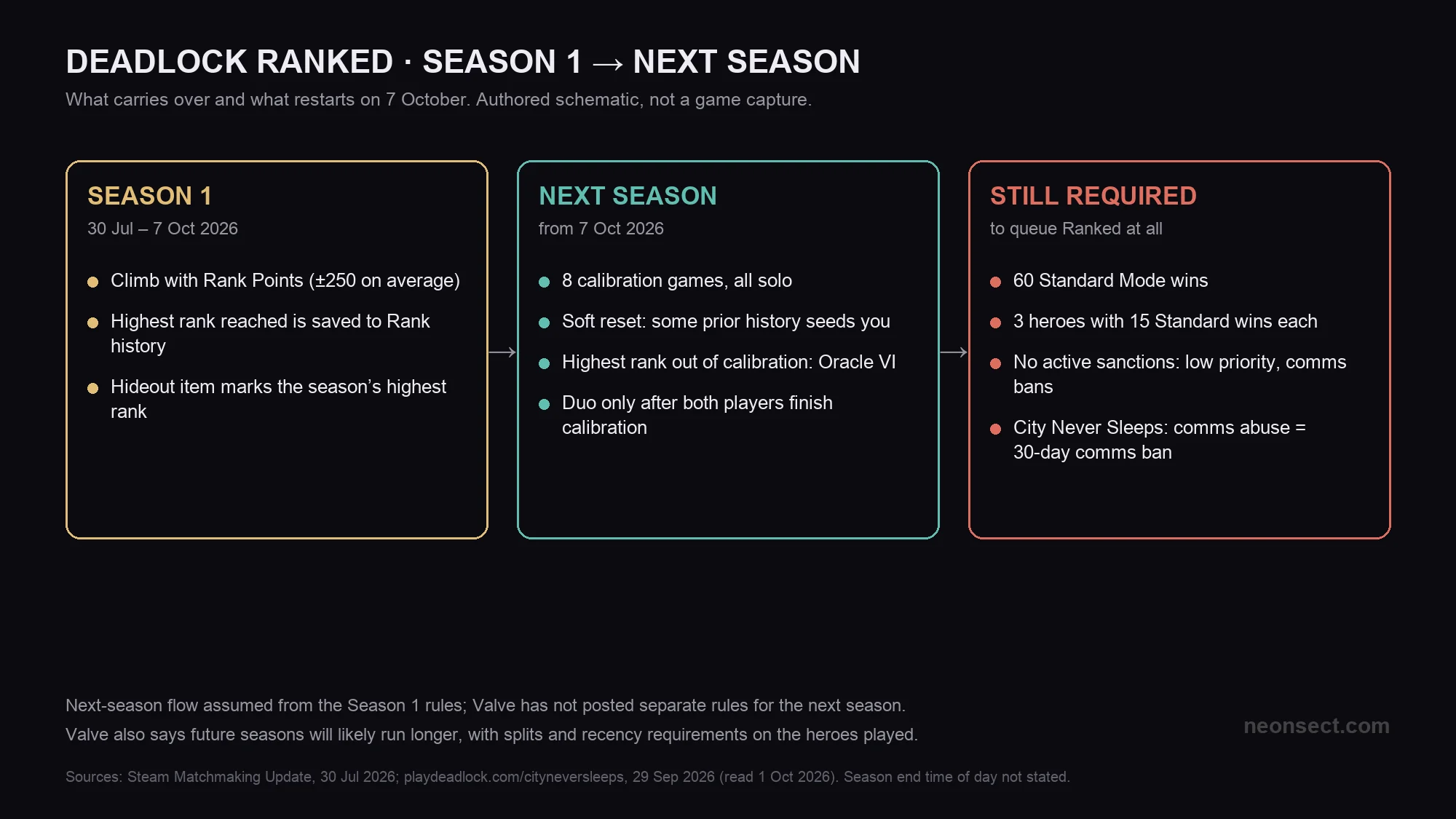
Valve’s 30 July 2026 post set the first Ranked season to end on 7 October 2026. On 6 October Valve pushed the end back to Thursday 5 November 2026 at 2pm PDT (21:00 UTC), with the next season starting immediately after. The rules below come from the 30 July post; Valve has not published different ones for the next season.
- Kept: the highest Rank you reached is permanently saved to your Rank history page, and a hideout item commemorates the season’s highest rank once the season is over.
- Restarts: the post describes the start of a season as an 8-game calibration with a soft reset of your prior Rank. All 8 games are solo, and duo opens only after both players finish. Valve has posted no different rules for the next season.
- Ceiling: the highest Rank out of calibration is Oracle VI; Phantom, Ascendant and Eternus are earned afterwards.
- Later seasons: Valve says future seasons will likely be longer, with splits (breaks within the season where Rank adjustments are made) and recency requirements on the heroes played. None of that has a date yet.
If you are one subrank short of a milestone, the days before 5 November are the last chance to have it saved as your Season 1 peak. Two City Never Sleeps changes touch Ranked as well: six new heroes release from 2 October 2026, two a week, and each needs 15 Standard wins from you before Ranked lets you pick it; and abusing comms now earns a 30-day comms ban, which blocks the Ranked queue while it is active. How bans treat those new heroes is in our Deadlock hero bans guide.
| Rango | Subranks | Points to Promote | Notes |
|---|---|---|---|
| Obscurus | Uncalibrated | Ninguno | Starting state every season until calibration finishes |
| Iniciado | I – VI | 1,000 / 2,000 final | First real rank after calibration for most new climbers |
| Buscador | I – VI | 1,000 / 2,000 final | Standard fixed-threshold progression |
| Acolyte | I – VI | 1,000 / 2,000 final | Standard fixed-threshold progression |
| Sentinel | I – VI | 1,000 / 2,000 final | Standard fixed-threshold progression |
| Mystic | I – VI | 1,000 / 2,000 final | Standard fixed-threshold progression |
| Ritualista | I – VI | 1,000 / 2,000 final | Standard fixed-threshold progression |
| Emisario | I – VI | 1,000 / 2,000 final | Standard fixed-threshold progression |
| Oráculo | I – VI | 1,000 / 2,000 final | Highest tier reachable straight out of calibration |
| Fantasma | I – VI | 1,000 / 2,000 final | Must be earned after calibration, never assigned directly |
| Ascendente | I – VI | 1,000 / 2,000 final | Must be earned after calibration, never assigned directly |
| Eternus | I – VI | Percentile-based | Top tier; thresholds recalculated daily, not fixed points |
How to Unlock Ranked Mode in Deadlock
Unlocking Ranked isn’t a single gate, it’s three separate counters that all have to clear before the queue button even lights up. Deadlock now requires you to earn at least 60 wins in Standard Mode before unlocking Ranked Mode, and you must also have at least three heroes with 15 unranked match wins each. Losses don’t count toward either number. The 60-win requirement applies to wins rather than matches played, so losing a Standard match does not move you closer to the total. The hero requirement is tracked separately per character, and the hero requirement is also separate from your overall wins — a hero only becomes available in Ranked after you have won at least 15 Standard Mode games with that specific hero. On top of that, players with active sanctions, such as Low Priority status or communication bans, cannot queue for Ranked matches. If you’re still working out how to even get into the game itself, our Deadlock access guide covers that earlier step before any of this applies. And if the win counts themselves are the part you would rather not grind, Acceso a competitivo exists to clear exactly these three counters.
| Requirement | Threshold | Why It Blocks New Players |
|---|---|---|
| Standard Mode wins | 60 total wins | Losses don't count, so this alone can take dozens of matches |
| Hero-specific wins | 15 wins per hero | Must be earned on each hero individually, not shared across a pool |
| Eligible heroes unlocked | 3 heroes minimum | Having 60 wins split across only one or two heroes still isn't enough |
Fastest Way to Grind Toward Ranked Eligibility
There’s no shortcut around the win counts themselves, but how you spend those Standard Mode games changes how quickly all three requirements clear at once. Spreading wins evenly across five or six heroes feels natural but actually delays Ranked access, since none of those heroes hits 15 wins as fast as if you’d committed early.
Consejo
Since hero wins don’t transfer between characters, pick your likely Ranked trio before you start grinding rather than after — chasing 15 wins on a fourth hero later just adds extra games on top of the 60 you already needed.
| Method | Speed | Effort | Best For |
|---|---|---|---|
| Commit to 3 heroes early | Fast | Medium | Players who already know their preferred roles |
| Duo queue Standard Mode | Fast | Low | Players with a regular co-op partner |
| Solo en cola individual | Medium | Medium | Players without a consistent duo partner |
| Rotate many heroes for practice | Slow | High | New players still learning the roster |
Party Restrictions: Solo, Duo, and the One-Rank Rule
Ranked parties are far more restrictive than Standard Mode’s open groups. Ranked currently supports only solo or duo queues, duo partners must be within one full Rank of each other, and Eternus players can only queue with other Eternus players and must be within three subranks. Valve has said this is a starting point rather than a permanent stance: Valve has noted these limits may be adjusted later based on feedback and population. Calibration adds an extra wrinkle on top of the party cap, since parties aren’t allowed at all until placement is done.
| Party Type | Rank Spread Allowed | Notes |
|---|---|---|
| Solo queue | No restriction | Always available once you're Ranked-eligible |
| Duo (below Eternus) | One full rank apart | A Mystic can queue with a Ritualist, not an Emissary |
| Duo (Eternus) | Three subranks apart | Tighter cap for the top tier specifically |
| Trio or larger | Not allowed | Restricted to Standard Mode only |
Calibration, Rank Points, and What You Unlock
Once you clear the win requirements, the season itself starts you at zero rather than dropping you straight onto the ladder. Every player runs through a placement phase, then earns points match by match, with a safety net built in against sudden drops.
Calibration: 8 Matches, Soft Reset, Oracle VI Ceiling
Every player begins a new Ranked season with a calibration phase, completing eight calibration matches before receiving a starting Rank. All eight calibration games must be played solo, with duo parties becoming available only after both players have completed their eight matches. It isn’t a blank slate, though: Deadlock uses a soft reset rather than treating every player as completely new, retaining some history from previous performance to seed players into appropriate calibration matches. Whatever that history suggests, there’s a hard ceiling on the way out: the highest Rank you can receive after calibration is Oracle VI, with Phantom, Ascendant, and Eternus needing to be earned after calibration ends.
Rank Points and Loss Protection
When you win or lose a game, your Rank Points update with a visible progress bar, with each win or loss granting +/- 250 points on average, though the number varies with the matchmaker’s expectations or win streaks. Progressing to the next Subrank costs 1,000 Rank Points, but the final Subrank before moving into a new Rank costs 2,000 points. That changes entirely at the top: once you reach Eternus I, thresholds are dynamically updated daily to segment the Subranks on a percentile basis instead of a fixed point total. Dropping rank isn’t instant either — players receive five games of protection when sitting on the boundary of a full Rank, and two games of protection when on a subrank boundary. Climbing once you are inside is a different job from getting in: only the win side of that ±250 swing moves the number, which is why a set number of net ranked wins is measured separately from unlocking the queue.
| Reward / Feature | How You Get It | Why It Matters |
|---|---|---|
| Ranked Hub access | Unlock Ranked at all | Shows season history, leaderboards, and past seasons in the hideout |
| Permanent rank record | Reach any rank during a season | Your highest achieved rank is saved forever, even after seasons reset |
| Season commemorative item | Finish the season above Obscurus | Cosmetic marker of your peak rank for that season |
| Global leaderboard eligibility | 75 matches in the last 30 days | Raised from the old 50-match bar, so casual players drop off it faster |
| Hero leaderboard eligibility | 30 recent games plus 100 lifetime wins | New lifetime-wins clause added on top of the raised 20-to-30 recent-game bar |
Players short on time can put Boosting de Deadlock alongside a normal playthrough rather than in place of one.
Core MMR and Hero MMR: The Two Numbers Behind Your Lobbies
Your rank badge is a readout. Underneath it the matchmaker keeps two separate numbers: a core MMR tied to your account, and a hero MMR built from your recent games on whichever hero you queued. That is why two players on the same subrank can get visibly different lobbies depending on which hero they locked.
Valve has reworked this more than once, so a lot of advice online describes a system that no longer exists. Ranked was removed on 21 November 2024, when standard and ranked matches were folded into one skill-based pool. On 30 July 2026 Valve reversed that and brought back a dedicated Ranked Mode beside Standard Mode. The ladder is new; the core-plus-hero rating underneath it is the same.
How Hero MMR Actually Changes How You Climb
Your MMR on each hero is an offset of your core MMR, based on your 20 most recent matches with that hero, and when you queue the matchmaker uses that hero’s number. If you are unfamiliar with a hero or play worse on it, you get an easier match than usual until the system has enough games on you with that character. That is why a fresh hero feels easy and your most-played one feels hard.
The flip side: spreading games across many heroes keeps every hero MMR low and noisy, while committing to a few lets each one settle close to your real skill, which makes both matchmaking and climbing more predictable.
Consejo
If you are trying to climb, play a small pool of two or three heroes so their hero MMR settles instead of restarting every time you try someone new. The three heroes you already took to 15 wins for Ranked eligibility are the natural pool.
Eliminación de prioridad baja
El número de victorias de baja prioridad que fijes, jugadas una a una
Step-by-Step: Path to Ranked From Zero
Advertencia
At launch on 30 July 2026 Valve warned that the first week or more would be unstable while players met the 60-win and hero-win requirements. When the next season starts on 5 November everyone calibrates at the same time, so expect a similar crunch in the first days; that is our expectation, not a Valve statement.
Sigue estos pasos para hacerlo rápidamente.
-
1
Confirm your Standard Mode win count
check the hideout or your profile stats to see how close you are to the 60-win mark; losses won't count toward it.
-
2
Pick your Ranked hero trio early
commit to three heroes you're comfortable with rather than spreading wins thin across the roster.
-
3
Grind 15 Standard wins on each of those three heroes
this can overlap with your 60-win total, so play the trio deliberately from the start.
-
4
Clear any active sanctions
Low Priority status or communication bans will block the Ranked queue even if the win counts are done.
-
5
Queue solo for your 8 calibration matches
parties aren't allowed until both requirements and calibration are finished.
-
6
Unlock duo queue after placement
once calibration ends, you can party up with a friend within one rank of you.
Why queues run long and matches feel uneven while the ranked pool is still thin is covered in Deadlock ranked queue times.
Common Misconceptions About Deadlock Ranked
Myth: The 60 Wins Have to Be on One Hero
They don’t. The 60-win requirement is a total across all of Standard Mode, while the separate 15-win requirement is what’s tracked per hero. You can hit 60 overall wins on a mix of characters and still need three of them individually past the 15-win mark before Ranked opens up.
Myth: Calibration Drops You Back at Your Old Rank
Calibration uses a soft reset, not a straight carryover. Your prior performance influences the matches you’re seeded into during the eight calibration games, but the outcome is capped at Oracle VI regardless of how high you previously climbed — Phantom, Ascendant, and Eternus have to be earned again through regular play afterward.
Myth: You Can Queue Ranked With Two Friends
Ranked tops out at duo parties. A three-stack, or any larger group, has to play Standard Mode instead — Ranked’s party cap and rank-spread rule only cover solo and duo queues, and Eternus tightens that further to players within three subranks of each other.
Myth: Hero MMR Is the Same as Your Rank
They are separate. Your badge reflects the account-level picture, while hero MMR shifts per character, which is exactly why a new hero can feel like a different game at the same badge.
Our Take: Is Deadlock Ranked Worth Unlocking Right Now?
Nuestra opinión
The system itself is solid, the entry cost is real, and 5 November sends everyone back through calibration.
Locking Ranked behind 60 wins and a three-hero pool at 15 wins each is a defensible way to keep a brand-new competitive mode from being flooded by players who haven’t found a hero identity yet. It also means the mode launches with almost nobody eligible on day one, which is exactly why Valve pre-warned about thin queues rather than letting players discover it the hard way. That’s an honest call on Valve’s part, and it’s worth taking at face value instead of assuming it’s marketing spin.
The subrank math (fixed 1,000/2,000 point thresholds, five-game rank protection, an Oracle VI calibration ceiling) is more structured than a lot of MOBA ranked systems at launch, and the loss protection window in particular should cut down on the tilt-fueled demotion spirals that plague other games. The duo-only, one-rank party cap is the part most likely to get loosened later, given Valve already flagged it as a starting position rather than a final decision. If you’re already sitting on a healthy Standard Mode win count, there’s little reason to wait; if you’re starting from zero, budget real time for the grind before you even see a calibration match.
¿Te ha resultado útil esta guía?
Servicios de Deadlock
Subida de rango
Subida de rango
Pick your current and target badge · Every division from Initiate to Eternus
Otros servicios
Eliminación de prioridad baja
The number of low-priority wins you set, played out one by one · Only wins count toward release, so the order is priced…
Subida de rango
Boosting de Ganancias netas
A set number of net ranked wins · Losses do not count against your total