
On this page
Return of the Ancients is the massive Patch 0.5.0 update for Path of Exile 2, launched on May 29, 2026, and developed by Grinding Gear Games. This update introduces extensive new content centered around the ancient Kalguuran runesmithing, including the Runeforging system, over 100 new runes, powerful crafting options, and the new Runic Ward defensive mechanic. The Return of the Ancients update also features five new endgame storylines, major overhauls to League Mechanics, and two new Ascendancy classes. This guide breaks down the Runes of Aldur league mechanic, the completely rebuilt Atlas system, how Runeforging and Runic Ward work, and where the two new Ascendancy classes sit in the meta. Runes of Aldur runs until the 1.0 full release on 11 December, so all of it is still current there — but since 4 September the newest league is Forbidden Rites, and patch 0.5.5 changed parts of the endgame for everyone.
TL;DR
- Runes of Aldur introduces Ezomyte Remnants, Runeforging, and over 100 runes that drop from league encounters across every zone
- Runic Ward is a new defensive layer that protects you from death after your life hits zero; added to armour via Verisium
- Atlas rebuilt with 30+ new areas, five new endgame storylines, multi-choice passive nodes, and Masters of the Atlas system
- Spiritwalker and Martial Artist are the two new Ascendancy classes for Huntress and Monk
- PoE 2 endgame fights require mechanical execution and combo-driven skill rotations, not one-button damage bursts
- Since patch 0.5.5 (4 September): Expedition is core content, the Trial of Chaos can be left and resumed, 17 new Soul Cores exist, and Runes of Aldur is no longer the newest league
Updated 4 September 2026 — this is no longer the current league
Patch 0.5.5 launched Forbidden Rites, a new event league with a fresh economy, on 4 September. Runes of Aldur has not been shut down — it keeps running until the 1.0 full release on 11 December, and unfinished challenges in it are still finishable, so everything below still applies there. What changed is the endgame around it: Expedition moved into the core game, the Trial of Chaos was reworked, and the Atlas gained new content. Those changes are summarised in the 0.5.5 section further down, and the new league is covered in our Forbidden Rites breakdown.
How the Runes of Aldur Mechanic Works
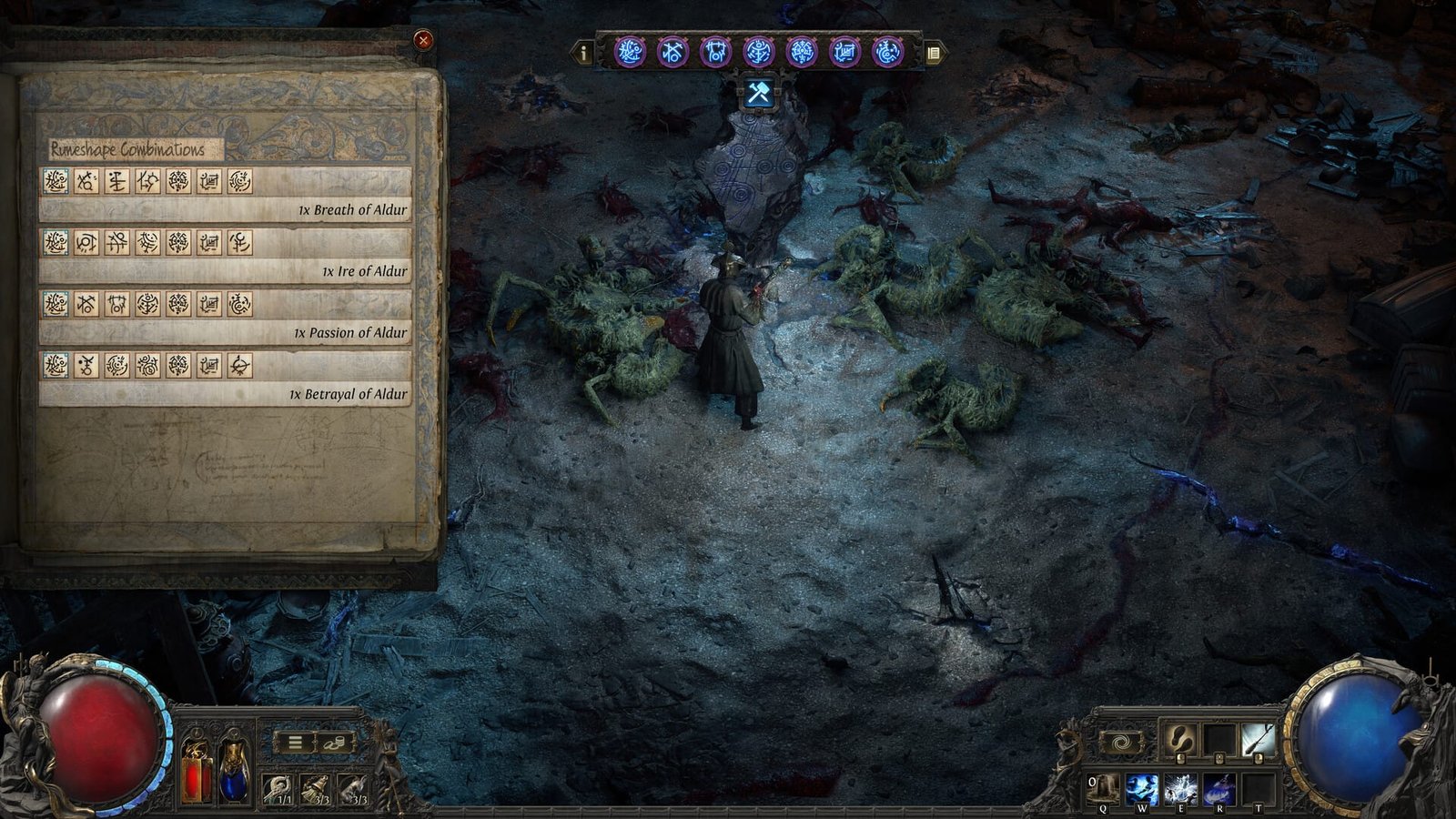
Runes of Aldur is the challenge league that shipped with patch 0.5 Return of the Ancients, live since May 29, 2026. It lives in every zone you walk through, starting in the first area of Act 1. The hook is an old Ezomyte Remnant, a stone slab carved with empty runic slots, that you finish by socketing Runes of your choice. Every area contains an ancient Remnant partially covered in symbols. In simpler terms click on the Remnant, choose one of the offered rewards, and start the encounter. Once you choose a reward, Runic enemies spawn around the Remnant empowered by the Runes you selected.
Longer Runesmithing recipes require more Runes, meaning that the summoned monsters become more powerful but also offer better rewards. In Runes of Aldur monsters summoned by the Remnant sometimes drop Verisium. This mineral can be used in Runeforging to empower your items with Ward. The Runes of Aldur league contains over 30 new monster types, over 100 Runes, Runic Alloys, Runeforging, several new Unique items, Bosses and Pinnacle Bosses, as well as dozens new Kalguuran Skills, Supports, Buffs and Runic Ward.
Anyone who would rather not spend the evenings on it can hand Path of Exile 2 boosting to our crew instead — same account, same progress, played by hand.
Runeforging and How to Use Verisium
Runeforging is the crafting bench behind the whole league, and you unlock its first tier early in Act 1 at the Verisium Anvil run by Farrow. It splits into two jobs: forging Runic Ward onto your armour, and rebuilding weak uniques into something worth keeping. The system runs on Verisium, the currency dropped by Remnant encounters, and unlocks in stages through the campaign. Act 3 opens Unique Verisium Runeforging, a second anvil recipe aimed squarely at uniques. Plenty of the best leveling uniques pack great modifiers on a low base, so they fall off hard once the rest of your gear catches up by maps. This reforges them at a higher item level: same unique, scaled numbers, back in contention deep into endgame.
Runic Alloys are a currency line of 13 items that work like Perfect Essences — they overwrite an existing modifier on an item with a guaranteed one, so you’re not gambling the whole slot. Olroth’s Legacy is the spicy one: socket it into a unique and it destroys that item, pulling one of its modifiers out as a Legacy Rune you can slot into other gear. There are also Runes that enable meta crafting. For example Uhtred’s Sidereus socketed into Boots adds special Chronomancy modifiers to the pool of possible outcomes when crafting that item. Uhtred’s Sidereus allows the item to roll the Chronomancy modifiers.
Runic Ward: The New Defensive Layer Explained
You add Runic Ward to armour through Runeforging. Armour below level 55 gains it for free, no stats sacrificed. Above level 55 the piece trades some of its regular defences for Ward, so it’s a build choice, not a freebie. Ward is a new type of resource that protects you from dying. Unlike Energy Shield which protects your Life pool, Ward takes damage after all of your Life is lost and you die when your Ward reaches 0. This makes it a last-chance buffer rather than a first-layer shield.
Ward does a second job that makes it more than extra health: it doubles as a resource. Kalguuran skills and supports spend Runic Ward instead of mana, so the same pool that eats hits also fuels your new gems. That pulls offence and defence onto one bar. Stack Ward and its regen and you buy survivability and casting headroom at once, which is why the whole league leans on it so hard. Added 8 Kalguuran Supports that can be crafted from remnants: Concussive Runes, Fist of Kalguur, Healing Runes, Kalguuran Conviction, Runeforged Blades, Runic Extraction, Runic Infusion and Scouring Flame.
Tip
Every Kalguuran skill you fire drains the same pool that keeps you alive, so builds leaning on them need steady Runic Ward regeneration or the whole kit stalls mid-fight.
Step-by-Step: Endgame Progression in Return of the Ancients
Follow this sequence to get it done fast.
-
1
Complete the campaign and unlock your first Waystones
After finishing Act 4, you gain access to the Atlas and can begin running Waystones to open new map tiers.
-
2
Activate your first Precursor Tower to unlock the Fortress
Completing a nearby Precursor Tower triggers a cutscene where the Precursor Fortress emerges. The Precursor Fortress covers a relatively large area on the Atlas, with connecting map nodes and special points of interest inside.
-
3
Begin the Origins of Divinity questline to earn Atlas
Guided by the Vaal thaumaturge Doryani, Exiles must embark on a journey to find the Precursors—the ancient architects of the Third Edict. This questline leads players through forsaken maps to locate and unseal a massive, long-dormant Fortress. Inside, the gameplay shifts toward complex exploration w
-
4
Choose your Atlas Master specialization
Players align with one of three Atlas Masters: Jado (Order of the Djinn) — artifact recovery missions; rewards include extra unique drops from map bosses or corrupted waystone modifiers · Hilda (monster hunter guild) — assassination missions; can make pinnacle bosses single-attempt but guarantee dou
-
5
Run the five new endgame storylines to unlock Pinnacle
Each mechanic (Breach, Delirium, Ritual, Expedition, and Runes of Aldur) has a dedicated zone, questline, and pinnacle boss; completing them unlocks crafting systems and Atlas passive upgrades.
-
6
Farm the Arbiter of Divinity pinnacle fight
The new pinnacle boss is Arbiter of Divinity, accessed via two new Citadel maps with two new bosses that drop the keys. Defeating Arbiter of Divinity five times alternatively completes a whole Fortress section for Atlas Tree points — an efficient path for late-league rerolls.
Best Runes and Crafting Outcomes to Farm
For more on general currency farming strategies and which maps to prioritize, check the PoE league starter guide for efficient Atlas pathing.
| Rune / Crafting Tool | How to Get It | Crafting Outcome | Best Use |
|---|---|---|---|
| Verisium | Dropped by monsters from Remnant encounters | Adds Runic Ward to armour | Core defensive layer for any build; mandatory on all armour pieces by endgame |
| Runic Alloys | Reward from Ezomyte Remnants | Replace a random modifier with a guaranteed one | Targeted affix swaps; better than chaos-spamming for specific mods |
| Olroth's Legacy (Aldur's Legacy) | League-specific currency drop | Destroys a unique, extracts one mod as a socketable Legacy Rune | Pull premium mods from niche uniques and socket them into best-in-slot rares |
| Uhtred's Sidereus | Specific rune drop from Remnants | Enables Chronomancy modifiers on the item | Meta-crafting; unlocks normally impossible affixes on boots |
| Unique Verisium Runeforging | Unlocked in Act 3 via Farrow's questline | Upgrades low-level uniques to higher item level | Extends leveling uniques into endgame viability; cost-effective power spike |
The Restructured Atlas and Multi-Choice Passive Nodes
The expansion entirely restructures the Path of Exile 2 endgame, introducing over 30 new areas to explore on the Atlas (ranging from the deserts of Maraketh to lava-filled dungeons), a completely reworked Atlas Tree with multi-choice nodes, and 5 New Endgame Storylines. The new Atlas Passive Tree has over 300 nodes and over 200 allocable passive points. Every node can eventually be allocated on a single character, so atlas respeccing has been removed as a concept. Flexibility comes from multi-choice nodes — many nodes offer two or three options swappable at any time without cost. League-start choices matter less because the end-state is full allocation; the variable that matters most is which multi-choice options you flip per farming session.
Each endgame mechanic now has a fixed location on the Atlas rather than spawning randomly. Endgame content can now be found in designated areas on the Atlas. So, if you just want to complete Breach Maps, you can simply head towards the southern portion of the Atlas. Each one ties directly into boss access, progression paths, and crafting systems. Following them is the intended way to experience the reworked endgame. Each storyline introduces a mechanic from a previous league alongside a dedicated crafting system.
Five New Endgame Storylines
Each storyline features dedicated questlines, hubs, and unique mechanics: The Origins of Divinity serves as a central pillar of the endgame overhaul, set against the backdrop of a Wraeclast ravaged by creeping corruption. At the heart of the Fortress lies a climactic confrontation with a mighty pinnacle boss — the First Edict. The five are: Tangmazu, the Raven Trickster storyline, accessed through fog-covered areas in the Delirium content · Keepers of the Flame storyline, where you help Ailith’s monks fight wave-based Breach encounters · King in the Mist storyline, centered on freeing a woman’s spirit through Ritual content · Atlas Masters storyline, tied to the new Masters of the Atlas progression system · Rog’s Missing Wife storyline, sending you across a procedurally generated ocean in the Expedition overhaul
Reworked Expedition: Ocean Exploration
Expedition has been transformed into a full ocean exploration system. Using Logbooks, you scout procedurally generated routes that reveal islands with basic Expeditions, Greater Expeditions, boss encounters, and eventually a new Pinnacle Boss. The storyline follows Rog searching for his missing wife Gwennen. Bosses like Medved and Uhtred serve as milestones within this structure. There is now a hub area “The Ruins of Kingsmarch” for The Runes of Aldur to the south-east of your starting location on the Atlas. The Logbook mechanic has been changed into an Ocean Exploring mechanic. Using logbooks now unveils a section of the ocean with a variety of islands to explore.
Spiritwalker and Martial Artist: The Two New Ascendancy Classes
There are 2 new ascendancies coming to Path of Exile 2 with Return of the Ancients. The Spiritwalker Ascendancy for the Huntress stalks through dark forests with animal companions by her side. Meanwhile, if you prefer to talk with your fists, consider the Monk’s Martial Artist Ascendancy.
Spiritwalker (Huntress)
The Spirit Walker (Huntress): Bound to the wilds, this class calls upon Azmerian animal spirits to answer her will. The Spirit Walker can infuse the power of the Stag (for stampeding attacks), the Owl (for enhanced projectiles), and the Bear (to summon a giant companion). Unlocking the “Sacred Wisps” power combines all three for massive buffs. Through their guidance, she may subdue even the most formidable Beast Bosses across Wraeclast, binding them in spirit to fight beside her as trusted companions. When this node is taken, it gives you the ability to capture unique beasts, which includes bosses! Some of the bosses that you can tame include the Mighty Silverfist (from the Jungle Ruins in Act 3), Xyclucian the Chimera (from the Chimeral Wetlands in Act 3), and Rakkar, the Frozen Talon (from the Glacial Tarn in Act 4).
Martial Artist (Monk)
The Martial Artist (Monk): After decades of training, the Martial Artist has become a master of illusions and internal spiritual energy. Empowered by the runes socketed into his body via runic tattoos on his meridians, this class creates powerful illusions of himself, summons illusory shatterable bells to aid him, and excels at using his hands as weapons. Runic tattoos that let you socket runes directly into your character rather than into gear, giving the Ascendancy a mechanical identity that no other class shares. The Martial Artist’s runic tattoo system means your character itself becomes part of your crafting build. Plan your rune choices before committing, since the interaction between tattoo runes and Kalguuran skills can open up unconventional build paths.
Note
Both new Ascendancy classes benefit heavily from Runeforging and Runic Ward mechanics, making them strong league starter candidates for Return of the Ancients.
How Path of Exile 2 Endgame Differs from Path of Exile 1
Path of Exile 2 endgame bosses require active mechanical execution and cannot simply be burst down with raw damage. Boss arenas feature distinct phases with choreographed attack patterns, invulnerability windows, and environmental hazards that force positional play. One-button builds that trivialize content through sheer DPS do not exist in PoE 2; instead, the endgame rewards combo-driven skill interactions, layered defenses, and deliberate resource management.
Skill gem design in PoE 2 encourages multi-skill rotations. Kalguuran gems, for example, consume Runic Ward rather than mana, creating a shared resource pool between offense and defense. Players must balance defensive uptime with offensive burst windows, and cannot simply spam a single ability through every encounter. This shift from the one-button meta of PoE 1 to combo-based gameplay applies across all endgame content, from map bosses to Pinnacle fights like the Arbiter of Divinity.
The Atlas itself is structured rather than randomized. The Atlas system, which has been one of the most criticized aspects of Path of Exile 2’s Early Access, receives a ground-up redesign. Instead of a sprawling, loosely connected web, the endgame now centers around a massive Fortress that rises from underground, built around clear progression paths and structured storylines. Each major league mechanic (Breach, Delirium, Ritual, Expedition, Abyss) has a dedicated starting zone with its own quest chain leading to a pinnacle boss fight. This gives clearer goals and reduces the aimless map-chaining burnout that plagued earlier versions of PoE 2.
For more on optimized Atlas progression routes and mechanics, see the PoE mechanics guide.
What Patch 0.5.5 Changed About This Endgame
The 0.5.5 patch notes touch the endgame described above in four places. None of it requires playing Forbidden Rites — these are game-wide changes.
Runes of Aldur content moved into the core game
Farrow, Dannig and Expedition are now a core Atlas mechanic, including in Standard, and Expeditions appear from Act 4 onwards. The Verisium Anvil is unlocked by completing The Runeseeker quest in Act 4 outside the league, Farrow can be placed in your hideout in every league once that is done, and Expedition Uniques can go in the Unique Item Stash Tab everywhere.
One asymmetry worth knowing: Expedition Tablets can be found in Standard and Forbidden Rites but not in Runes of Aldur, and Aldur’s Saga stays exclusive to Runes of Aldur — though its special modifiers can appear naturally on Grand Expeditions when you run a Logbook elsewhere.
Stacking Expedition Tablets on a Map scales the site: one adds a Kalguuran Expedition; two add a Verisium Remnant and 35% increased Expedition density; three add a second Expedition; four add another Remnant and another 35%. Density here means more chests, monster flags and Verisium Remnants inside the site.
The Trial of Chaos was reworked
The change that matters most: you can now leave a Trial of Chaos run at any point and resume later from the same room. The old all-or-nothing rule is gone. Each room now ends in a reward chest, so dying costs the remainder rather than the run.
Rewards are now only Currency and Soul Cores — corrupted items are no longer an outcome. Completing an Inscribed Ultimatum with 10 Trials lets you continue immediately without another Ultimatum, twice per Ultimatum, carrying modifiers and reward quality forward, with an optional double-or-nothing wager. The Trialmaster stops time only at the start of a run instead of in nearly every room, and Uxmal’s arena was redesigned outright. Trials also gained inherent bonuses that scale with area level, compensating for Atlas passives not applying inside them.
Seventeen new Soul Cores, and limits on old ones
Thirteen Jiquani’s Soul Cores (Automation, Malediction, Targeting, Rallying, Radiance, Severing, Rippling, Quaking, Munitions, Snares, Abundance, Squalls, Thundering) and four Atziri’s (Devotion, Vitality, Alacrity, Inoculation) were added.
Several existing Soul Cores now carry a Limit of 1 — among them the Soul Cores of Jiquani, Opiloti, Puhuarte, Ticaba, Topotante, Tzamoto, Xopec and Zalatl — with their numbers raised in exchange. If a build in this guide stacked duplicates, that is the line to re-check before rebuilding it.
Atlas and boss changes
Large Abyssal Ravines can now appear across the Atlas, and Maps found on them are guaranteed to contain Abysses. Defeating the Arbiter of Divinity with the non-quest Origin Core now completes the entire Precursor Fortress for the Map owner, letting you allocate the Atlas passive tree as you like. Corrupted Nexus Maps can be retried after a failure — previously failed ones were uncompleted so they can be run again. And the Arbiter of Ash lost its blanket elemental resistance: it now has Fire Resistance and Cold Vulnerability, which is a direct instruction about what to bring.
Common Misconceptions About Return of the Ancients Endgame
You Can Skip Runeforging and Still Clear Endgame
Technically true for low-tier maps, but false for Pinnacle content. Runic Ward is not optional once you hit red maps. Boss encounters like the Arbiter of Divinity have damage spikes that will kill you through capped resistances and a full life pool, and Runic Ward is the only defensive layer that protects you after your life depletes. Skipping Verisium Runeforging on your armour means skipping the cheat-death buffer that keeps you alive during oneshot mechanics.
You Need to Respec Your Atlas Tree Constantly
The new Atlas Passive Tree has over 300 nodes and over 200 allocable passive points. Every node can eventually be allocated on a single character, so atlas respeccing has been removed as a concept. The multi-choice nodes let you flip between options without cost, so switching from Breach farming to Expedition farming is instant. Early Atlas choices matter far less than in PoE 1, since full allocation is the long-term goal.
The New Ascendancies Are Mandatory for Endgame
Not true. Spiritwalker and Martial Artist are strong, but existing Ascendancy classes remain competitive. The new Atlas Tree, Runic Ward, and Kalguuran skills are accessible to all classes, so build diversity remains wide. Spiritwalker’s beast-taming is powerful for minion builds, and Martial Artist’s runic tattoos open new crafting paths, but neither is required to clear the Fortress or Pinnacle bosses.
Our Take: Is Return of the Ancients Worth It?
Our Take
Return of the Ancients is the first PoE 2 expansion that nails endgame structure, but the crafting loop is grindy and the reward pacing is uneven.
Runeforging and Verisium are front-loaded into every zone, so you’re constantly hitting Remnants, but the actual crafting outcomes feel incremental rather than transformative. Runic Ward is mandatory, which means you’re spending Verisium just to meet baseline survivability rather than chasing exciting upgrades. The real power is in Olroth’s Legacy and the meta-crafting runes like Uhtred’s Sidereus, but those are rare enough that most players won’t see them consistently until deep into red maps.
The Atlas rework is the strongest part of the expansion. Fixed points of interest and dedicated storylines give the endgame a sense of progression that Early Access PoE 2 badly needed. The five new storylines are uneven—Origins of Divinity and the Expedition ocean exploration feel fleshed out, while the Ritual and Abyss updates are thinner—but all of them beat the old aimless map-chaining loop. The multi-choice Atlas nodes remove friction without dumbing down customization, and the Masters of the Atlas system is genuinely clever; swapping between Jado, Hilda, and Doryani changes farming strategies without forcing a full respec.
The new Ascendancy classes are solid additions. Spiritwalker’s beast-taming is niche but powerful for minion builds, and Martial Artist’s runic tattoos open build paths that no other class can touch. Neither is mandatory, but both feel mechanically distinct enough to justify rolling a new character. The bigger takeaway is that PoE 2 endgame now requires actual mechanical play—boss phases cannot be skipped with raw DPS, and combo-driven skill rotations replace the one-button spam meta of PoE 1. That shift will frustrate some players, but it makes the endgame feel like a real test of build knowledge rather than a gear check.
Was this guide useful?